


Five things about Canadian Jeremy Hansen’s upcoming trip to the moon and back
By Canadian Press on January 17, 2026.
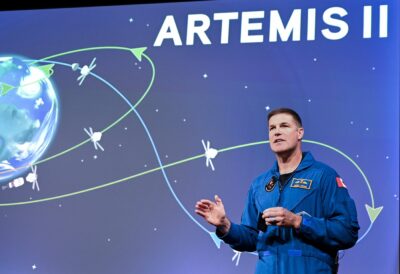
LONGUEUIL — Astronaut Jeremy Hansen is set to make history as the first Canadian to fly around the moon. The Canadian Space Agency is hoping this “once-in-a-generation” event is one that will inspire young people to dream big.
The impending Artemis II mission to the moon and back is in its final preparation stages with a potential launch window opening as soon as early February.
Hansen, 49, of London, Ont., will serve as mission specialist during Artemis II, becoming the first non-American to travel beyond low Earth orbit, a historic achievement for Canada. His crewmates are NASA astronauts Reid Wiseman, Victor Glover and Christina Koch. Artemis II will be the first crewed mission to the moon since 1972 — the year of the final Apollo mission.
“We believe this Artemis II mission for Canadians, it’s a little bit of a once-in-a-generation mission … people will remember where they were when the launch happened and when the mission happened,” Annie A.-Bélanger of the Canadian Space Agency said in a recent interview.
Here are five things about the Artemis II mission as its crew awaits launch day.
What’s next for the mission
On Saturday, the SLS rocket — the vehicle designed to launch the Orion spacecraft — is scheduled to be transferred from NASA’s vehicle-assembly building to the launch pad at the Kennedy Space Center in Florida, about 6.5 kilometres away. The rollout is expected to take about 12 hours.
Before the end of the month, the crew and mission team will conduct a wet dress rehearsal — a simulated launch — at the space centre. Only after that rehearsal will the management team assess when to launch. NASA has identified several launch dates over the next few months, with the earliest being Feb. 6. It plans to hold the mission no later than April.
Following the roughly 10-day mission, the craft is expected to splash down in the Pacific Ocean.
In addition to Hansen, fellow Canadian astronaut Jenni Gibbons, 37, of Calgary, is serving as Hansen’s backup and will be supporting the crew from the ground control.
A chance to ask a question to Jeremy Hansen while he’s in space
The Canadian Space Agency will be accepting questions in French and English until Jan. 23 and will pick a few submissions at random to present to Hansen while he is in orbit. Bélanger says the agency will select questions from a diverse array of Canadians “from coast to coast to coast.”
“It’s a very special moment that you remember for a long time and we want to make sure that Canadians have this opportunity to ask questions,” Bélanger said.
Questions can be submitted on the CSA’s website: https://www.asc-csa.gc.ca/eng/news/articles/2026/2026-01-16-ask-astronaut-jeremy-hansen-question-during-artemis-ii-mission.asp
Delays are possible
It’s not uncommon for space missions to be delayed — the Artemis II had been planned for September 2025 but was pushed to early 2026.
In late November 2022, NASA launched Artemis I, involving an NASA Orion spacecraft that did not contain a crew and orbited the moon before returning to Earth. That 25-day mission was also delayed.
NASA has identified dates that run between February and April, so there’s a large window in which to launch.
“Any space launch is complex: it requires a lot of technical things to go absolutely perfectly (and) weather is another component and so up to the last minute, we are used to seeing launches that could be postponed or just cancelled for another date,” Bélanger said.
Watch parties planned across the country
“One of our goals is really to make sure that people and Canadians take can take part in that mission,” Bélanger said, adding the CSA will provide updates on the mission on the agency’s various social media channels.
Some watch parties are already planned at science museums across the country, the locations for which can be found on the CSA website. The agency has also created a watch party tool kit for people planning to witness the historic launch at home with family and friends.
As most of the potential launch windows are late in the evening, it won’t likely be something students will see live in the classroom. But Bélanger says milestone events will be streamed live and available after. The agency also has some science-related activities and projects for teachers.
“We’ve seen the excitement of students all across Canada and Jeremy has been doing virtual connections with many schools, thousands of students,” Bélanger said. “It’s something that is very important to him (and) very important to us as well to make sure that students know what’s happening.”
More than 50 years after Apollo, an inspirational mission
“A lot of our Canadian astronauts were inspired by the Apollo missions, so it’s a way (to inspire younger generations),” Bélanger said, adding that space travel can motivate young people to study science, technology, engineering and math.
Artemis II will set the stage for subsequent missions to land astronauts on the moon’s south pole and to begin assembling the Gateway lunar space station, which will be a small lunar outpost that will orbit the moon. The station will include a Canadian contribution — Canadarm 3 — described by the CSA as a robotic system using “cutting-edge software to perform some tasks around the Moon autonomously, without human intervention.”
This report by The Canadian Press was first published Jan. 17, 2026.
Sidhartha Banerjee, The Canadian Press
32-31