


Carney courts investment at World Economic Forum in Switzerland
By Canadian Press on January 19, 2026.
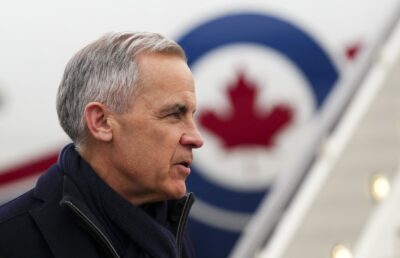
OTTAWA — Prime Minister Mark Carney arrived in Switzerland on Monday to join the global power elite for the World Economic Forum in the ski resort town of Davos, where he’s looking to drum up investment from other countries and corporations.
The forum puts Carney together with the movers and shakers he encountered during his past work as a central banker and United Nations envoy. The Conservatives have pledged to boycott the event entirely, saying the attendees are out of touch with the needs of Canadians.
“It is a clearly a significant meeting of what you might call globally influential elite, coming from a variety of backgrounds (and) those representing capital around the world,” said University of British Columbia political scientist Stewart Prest.
“There can be a celebrity element as well, and leading policy-makers from around the world are present.”
This summit is happening “at a moment of populist frustration with politics,” Prest said, adding Carney’s attendance risks courting voter backlash against “what seems like a cushy gig.”
But U.S. President Donald Trump’s global trade war and threats against national sovereignty make attending Davos less politically risky for Carney right now, Prest added.
“There is still suspicion of that kind of global wealth and power, but there is also a recognition that these are difficult times, and that Canada needs to find allies wherever it can,” he said.
Conservative Leader Pierre Poilievre has railed against “globalist Davos elites” and has pledged to ban any cabinet led by him from attending the WEF, an organization that has been the subject of numerous conspiracy theories.
Prest noted that former Conservative prime minister Stephen Harper attended Davos in 2010 and 2012, when the country was recovering from the global recession and still played “a muscular role in the world” through its resilient banking sector and its contribution to the NATO mission in Afghanistan. Poilievre was an MP in Harper’s caucus at the time.
“Canada then, as now, had something to say that other countries would be interested in hearing, and Mr. Harper — as any good politician would — took advantage of that,” he said.
“Poilievre was essentially part of a government that took active part in these kinds of discussions, for the same reasons that we see Mr. Carney doing so.”
Former prime minister Justin Trudeau also attended Davos in 2016 and 2018, though Prest said he did not have the same gravitas that Carney brings to the summit.
“(Carney) is somebody who doesn’t really have to justify his presence in a conversation like this, because he … very clearly understands macroeconomics in a granular way. And so that means it’s a different proposition for him to go to a place like Davos,” he said.
“He is speaking the language of those who are there, and they are going to be interested in what he has to say — not only as a representative of Canada, but actually as someone with considerable expertise and background in the issues that are going to be discussed.”
Carney is set to give speeches Tuesday and Wednesday aimed at luring investment to Canada before returning to Ottawa.
He is set to leave Switzerland on Wednesday and might depart before Trump is set to speak at Davos, at 9:30 a.m. Ottawa time.
Trump’s unpredictability could upend the entire gathering, Prest said.
“The United States looks to be actively trading away its status as a global hegemon with interests and influence around the world for a kind of Western hemispheric bully. That is a remarkable retrenchment. It is a step back,” he said.
“The world, in a realist lens, is a matter of finding ways to defend your own sovereignty, and support the prosperity of your country, by whatever means necessary.”
This report by The Canadian Press was first published Jan. 19, 2026.
Dylan Robertson, The Canadian Press
24-23