


Chinese ambassador urges Canada to move quickly to implement deals signed in Beijing
By Canadian Press on January 22, 2026.
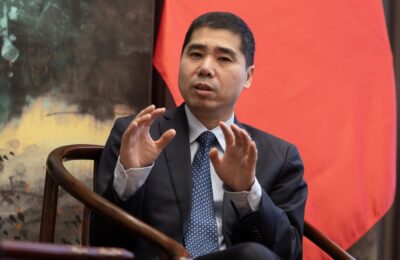
OTTAWA — China’s ambassador to Canada is urging the government to make progress quickly on areas of collaboration both countries agreed to during Prime Minister Mark Carney’s visit to Beijing last week.
“As long as both China and Canada have adequate sincerity, both sides will be able to translate the important outcomes into reality,” Chinese Ambassador to Canada Wang Di told The Canadian Press in his first interview since Carney’s Beijing visit.
“The most important task for both sides is to respond as soon as possible to the expectation of the two peoples and to move along the direction that has been pointed out by the leaders of our two countries.”
During the visit, President Xi Jinping and Carney agreed to resolve a tariff dispute that had Beijing impose levies on agricultural goods from Canada in retaliation for Ottawa’s tariffs on electrical vehicles from China.
The two sides also signed memorandums to reboot working groups and institutional mechanisms that touched on fields such as finance, lumber, oil, green technology and tourism. Wang said these agreements mean that government departments in China and Canada will be in touch more often, and will move faster on priority areas.
Carney has said he’ll return to China in November for the APEC summit in the city of Shenzhen. Wang said that gives both sides 10 months to make progress on deepening their collaboration.
“That requires us to lose no time and work faster to achieve more outcomes” so that both leaders “will be able to discuss the future development of China-Canada relations at a higher level,” Wang said through his interpreter.
Agriculture Minister Heath MacDonald told reporters Thursday he’s working with stakeholders to make progress on last week’s agreements.
“We were leaning on some open doors. Those doors have opened. We need to act quickly and that’s what we’re trying to do,” he said in Quebec City where he is taking part in a cabinet retreat.
The areas of agreed collaboration between the two countries did not include those Carney has deemed sensitive to Canada’s national security, such as artificial intelligence, critical minerals and defence.
Analysts also have flagged these sectors as important to the Americans — which raises the risk of continental trade talks with Washington being upended if Canada opens up too much to China.
Wang said Beijing is aware of these concerns and is trying to pursue deeper collaboration.
He noted Beijing’s call for “seeking common ground while reserving the differences,” a motto China has used for years in statements regarding Canada.
“The character of China-Canada relationship is win-win and mutual benefit. China and Canada are also highly complementary with each other,” Wang said.
“There is great potential and promising prospects for China and Canada to leverage our complementary advantages and realize mutual benefits. But of course, at the same time, we do not deny that there are differences between China and Canada.”
Sergio Marchi, a Chrétien-era trade minister and former ambassador in Geneva, said it makes sense for Canada to be clear on where it’s willing to engage in China and what’s off the table.
“We can’t do the entire waterfront. I think we should pick our spots,” Marchi told an online panel held by the Institute for Peace and Diplomacy on Thursday.
He argued Ottawa should invite Xi or his premier to visit Canada and keep up regular communication and trade missions, an approach former prime minister Jean Chrétien took to avoid derailing bilateral relations.
“Problems didn’t fester. They were meeting often enough that they could address those issues in real time with real success,” Marchi said. “If there is trust, scars can heal.”
Henri-Paul Normandin, a former diplomat posted twice to China, told the panel that Canada still needs to focus on spreading its trading relationships among many nations — both to accommodate Canadians’ concerns about greater engagement with China and to prevent “over-dependence on the Chinese market.”
“We’re never far away from a situation where things can go off-rail,” he said, citing Chinese political interference, its human rights record and the possibility that Canada could be asked to join U.S. naval exercises near Taiwan.
Carney has sought to frame his approach as a “recalibration” of Canada’s relationship with China, instead of a full reset.
That means Ottawa still has concerns about foreign interference, human rights and China’s actions in the South China Sea — but is also emphasizing potential areas of co-operation with China instead of matters where the two countries deeply disagree.
It’s not clear what that means for Ottawa’s Indo-Pacific strategy, released in late 2022, which called Beijing a “disruptive global power” whose values increasingly differ from those of Canada. The strategy called for more collaboration with various Asian nations to limit Canada’s exposure to Beijing.
In October, Foreign Affairs Minister Anita Anand said she told her department to update the strategy, saying it no longer reflects evolving relations with both China and India.
Wang said it’s up to Canada to decide what a new regional strategy looks like but admitted the Indo-Pacific strategy caused Beijing “serious concern.”
“The Indo-Pacific strategy is inconsistent with this new strategic partnership, with the new era that we are in, and with the policy that the Canadian government is having,” he said.
Analysts have urged caution in Canada’s engagement with China. Some have suggested Canada should pragmatically raise concerns on issues like human rights, and escalate those concerns publicly through joint statements with like-minded countries.
Others have accused Beijing of trying to buy countries’ silence by using its economic clout.
Wenran Jiang, head of the Canada-China Energy and Environment Forum, told Thursday’s panel that Ottawa should “examine if our narrative about China is all too rigid” for an era of geopolitical disruption.
He also said Ottawa needs to take a unified approach to China, instead of allowing provincial concerns to be exploited by Beijing.
“Then we’ll be negotiating with the Chinese on the position of strength instead of fragmented regionalism,” he said, adding Ottawa can boost its negotiating position by making sure infrastructure projects like pipelines are built within years of being first proposed, instead of decades.
Wang said Canadians and Chinese are facing a turbulent world and they expect their leaders to provide opportunity and stability. Industry leaders on both sides have “very high expectations” from the visit, he said, and so it’s now up to officials to “translate the important outcomes of this visit into reality as soon as possible.”
Wang also said he hopes to see Canada-China ties deepen when Anand welcomes her Chinese counterpart, Wang Yi, to Canada at some point this year.
“History has proven it very well that whenever China and Canada pull in the same direction toward the same goal, we have been able to achieve a lot,” the ambassador said.
This report by The Canadian Press was first published Jan. 22, 2026.
Dylan Robertson, The Canadian Press
-39