


Ottawa remains opposed to acquiring nuclear weapons, minister says
By Canadian Press on February 3, 2026.
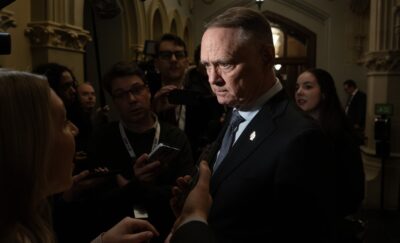
OTTAWA — Canada has “absolutely no intention” of acquiring nuclear weapons, Defence Minister David McGuinty said Tuesday — rejecting the suggestion from former chief of the defence staff Wayne Eyre that Ottawa should not rule it out.
McGuinty said Canada has signed international treaties explicitly opposed to the proliferation of nuclear weapons.
“Canada is a signatory to international treaties which preclude us, number one, and Canada has been a non-nuclear-proliferation state for a long time,” McGuinty told reporters on his way into a cabinet meeting Tuesday.
“We are going to continue to build conventional weapons. We’re going to continue to re-arm. We’re going to continue to reinvest. We’re going to continue to rebuild our Canadian Armed Forces and we’re doing that.”
Eyre suggested at an event in Ottawa on Monday that Canada shouldn’t altogether rule out acquiring nuclear weapons.
Both The Globe and Mail and La Presse reported that Eyre said Canada may never have true strategic independence without its own nuclear deterrent.
But the retired general also reportedly said nuclear weapons are not something the country should acquire at the moment.
Bloc Québécois Leader Yves-François Blanchet told reporters Tuesday that the Liberal government was right to quickly dismiss the idea and is satisfied the federal government doesn’t want to go there.
Eyre made the comments at the Rideau Club in Ottawa during a discussion arranged by the Conference of Defence Associations Institute, a defence think-tank, and the Ottawa-based consultancy Catalyze4.
The discussion was focused on Canadian sovereignty and the limits of the country’s military autonomy in a shifting geopolitical landscape. It appears not to have been publicly broadcast.
Nuclear arms have returned to the fore as a pressing concern in international relations. The New START treaty, a key anti-proliferation pact between the U.S. and Russia, is set to expire on Thursday, sparking fears of a looming global arms race.
U.S. President Donald Trump’s dismissive attitude toward the NATO alliance, his push to seize Greenland and an aggressive new U.S. security posture have leaders in Europe debating how much the U.S. can be counted on for help.
Trump’s disruptive actions have spurred discussion over whether more countries need to acquire nuclear weapons to protect themselves from Russian land grabs in the absence of U.S. protection.
On Jan. 10, one of Sweden’s largest newspapers proposed a joint “Nordic” nuclear program with partner countries. On Jan. 25, Swedish Prime Minister Ulf Kristersson reportedly said on his country’s public broadcaster SVT that Stockholm has entered preliminary talks with France and the U.K. about potential nuclear weapons co-operation.
Like Sweden, Canada is a non-nuclear state and a signatory to the international treaty on the non-proliferation of nuclear weapons. That international pact bars signatories without nuclear arms from acquiring or producing them.
Commonly known as the NPT, the treaty serves as the foundation for the global disarmament movement. Canada has strongly supported the treaty since it came into force in 1970.
This report by The Canadian Press was first published Feb. 3, 2026.
Kyle Duggan, The Canadian Press
21-20