


Oral HIV self-test approved for sale, advocates say it’s key to elimination
By Canadian Press on February 10, 2026.
TORONTO — An oral, at-home HIV test that delivers results in as little as 20 minutes and has been used in the U.S. for well over a decade is finally coming to Canada.
OraSure Technologies announced Tuesday its OraQuick HIV self-test received a licence to distribute from Health Canada.
While it’s not the first self-test on the market in Canada, it’s the first oral swab, which doesn’t require a drop of blood. The oral option looks like a popsicle stick with a flat pad on one end that’s swabbed along the gums.
Experts say the less invasive, more portable option — an alternative for people who are queasy or hesitant about blood — offers a renewed sense of hope in reaching Canada’s goal of eliminating HIV as a public health threat by 2030.
For years, new HIV diagnoses steadily rose — from 1,800 in 2022 to 2,434 in 2023. There was a small decline to 1,826 in 2024. But Manitoba and Saskatchewan have three or four times the national rate of new diagnoses.
Dr. Sean Rourke, a scientist at MAP Centre for Urban Health Solutions at St. Michael’s Hospital, tapped as the exclusive distributor of the OraQuick test in Canada, said he can finally see the elusive finish line of the 2030 goal.
However, he said reaching it will rely on governments funding front-line agencies to go into communities and offer the test for free.
Rourke said his team at St. Mike’s will start taking orders in the coming weeks from health providers, front-line agencies and hopefully, governments.
“This is the gap that we’ve been missing to reach the people who need it the most,” Rourke said, speaking about communities that are at increased risk as a result of health inequities. That includes African, Caribbean and Black communities; gay, bisexual and other men who have sex with men; people who use and inject drugs; and Indigenous Peoples.
WHAT IS AN ORAL FLUID HIV SELF-TEST?
The oral fluid HIV self-test involves sliding a flat pad attached to a stick along the top and bottom of the gums, an area that contains a high concentration of early HIV antibodies.
The swab is then inserted into a cartridge for about 20 minutes. Just like a PCR test, a control line will show up, and if another one appears, that means it’s detected HIV antibodies.
Research shows the performance of the test is statistically equivalent to the blood-based HIV test. The oral test was approved in the United States in 2012, recommended by the World Health Organization in 2016, and is used in 60 countries.
Rourke said the reason Canada is “late to the game” is suppliers needed proof there was a market for the test and Health Canada needed assurance that it reached their standards.
To do so, his team has partnered with community-based front-line organizations across the country over the last five years to run clinical trials for the blood and oral HIV self-tests.
Rourke said they reached 100,000 people affected by HIV across Canada through a national government funded program that ran for 2 ½ years and helped hundreds of people get diagnosed.
“By doing that, we were starting to build that network of agencies across the country that we could then rely on for that continuity of reaching the right people who come to them, but maybe not go in the health system,” he said.
COMMUNITY OUTREACH
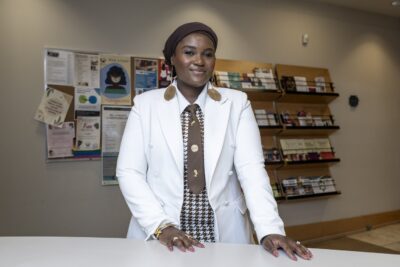
One of those organizations is Women’s Health in Women’s Hands, which serves African, Caribbean, Black, South Asian, and Latino women, trans and non-binary clients in Toronto.
The health centre’s research and outreach co-ordinator Nonty Nkala said involving community-based organizations is key in addressing historic mistrust.
“There’s a negative connotation to research because it’s always extractive. It’s never community-led. It’s never one where you are asking the person that you’re extracting this information from what they need, how they need it done. It’s not culturally appropriate. It’s not inclusive. All of these different things that have happened in the past that has made research something that people of color sort of hesitate to take part in,” she said.
Nkala said while offering the HIV self-tests at churches, festivals, shelters and community clinics during the research stage, she often addressed hesitation and mistrust.
“When research is being done by fellow Black people, is being led by Black people, and we’re sitting down and having conversations with folks who are otherwise apprehensive and then they’re saying, ‘hey, okay, so this is my people,’ you know, there’s a level of trust there,” she said.
Growing up in Zimbabwe, she said HIV awareness was everywhere, but here in Canada, she said new immigrants often feel silenced, like it’s a taboo topic to talk about.
On a corkboard at her office in downtown Toronto, a lime green poster reads, “HIV is still a thing.”
WHY DO WE NEED TWO SELF-TESTS?
McGill University professor Dr. Nitika Pant Pai, a global expert on point-of-care diagnostics for HIV and sexually transmitted and blood-borne infections, said the oral fluid HIV self-test didn’t initially take off in the U.S. because the majority of individuals affected by HIV could not afford to spend money out-of-pocket on the kit.
The Canadian government invested $8 million in the finger prick HIV self-tests in 2022, which was extended into 2024, but Rourke said since then, there’s been no federal government funding to distribute and reduce the cost of the tests.
Some provincial governments, such as Saskatchewan and Nova Scotia, have decided to fund their own HIV self-testing programs to keep the kits available.
Online, the blood test can be purchased for about $35. Rourke said the oral test will be priced between $15 and $20.
Nkala worries a similar withdrawal of support will happen with the oral test, but ultimately she sees it hitting the market as a good thing.
“At the end of the day, this is a device that is going to be absolutely key in terms of HIV prevention.”
This report by The Canadian Press was first published Feb. 10, 2026.
Canadian Press health coverage receives support through a partnership with the Canadian Medical Association. CP is solely responsible for this content.
Hannah Alberga, The Canadian Press
-37