


A search for mental health answers amid the trauma of Tumbler Ridge shootings
By Canadian Press on March 5, 2026.
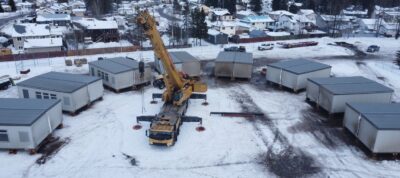
The metal-clad portable classrooms are arranged in a semicircle on a snowy sports field at Tumbler Ridge Elementary.
It’s a 15-minute walk from the community’s secondary school, where five students and a teacher’s aide were shot dead about three weeks ago and B.C.’s infrastructure minister calls the new buildings “an important step toward restoring routine & connection for students & staff” of the secondary school.
While some mental health experts say they understand the “knee-jerk reaction” to move the students, they warn of risks associated with “avoidance” and the unintended long-term impacts that may ensue.
Dr. Arash Javanbakht, a psychiatrist and the founding director of the Stress, Trauma and Anxiety Research Clinic at Wayne State University in Michigan, said there is a high likelihood of PTSD, depression or anxiety in the aftermath of such an event.
He said his research into childhood trauma shows PTSD does not always fade with time and can have ripple effects such as substance abuse or social anxiety that will need long-term interventions.
“Trauma at this level needs experts,” Javanbakht said in an interview. “It’s good to have experts available to screen these kids, find out who is impacted and then address it, offer the treatment and therapies when needed.”
He noted that PTSD often triggers avoidance, especially of locations where the trauma occurred. That, he said, should be prevented if possible.
Christy Fennell, the superintendent of the Peace River South school district, said in a letter to families on Feb. 13, just three days after the shootings, that students were not expected to return to Tumbler Ridge Secondary School.
The next week, the B.C. government announced that portables were being sent to the remote community in the Peace Region of northeast B.C., about 1,200 kilometres from Vancouver.
The Education Ministry said some students headed back to classes last Thursday, with the district planning a “gradual, trauma-informed return to learning.”
Ma shared photos of the temporary classrooms being installed in a post to social media on Tuesday.
“In the face of such loss, our focus is on providing stability, safety and a clear path forward for students,” she wrote.
The installation followed through on a promise made to students by B.C. Premier David Eby, at a vigil in Tumbler Ridge in the days after the attack, where he said “not one of you will ever be forced to go back to that school.”
Javanbakht said the decision to erect portables may have made sense in the immediate aftermath of the attack.
But he warned about reinforcing avoidance — and closing Tumbler Ridge Secondary permanently, he said, may have that unintended effect.
“Gradual exposure back to the school is important,” he said in an interview.
Javanbakht has not worked directly with the survivors in Tumbler Ridge, but said his suggestion would be to talk to the students and gauge whether they’d like to return.
“If the kids are able and willing and understanding, I wouldn’t deny them the right to going back to their own school.”
Amin Asfari is the Law Foundation of Saskatchewan Chair in Police Studies at the University of Regina, and has long studied mass shootings. He agreed with Javanbakht.
“I get the kind of immediate knee-jerk reaction, but does that actually address the underlying psychological trauma that they just experienced? No,” he said.
“Aside from making it easier for them to access education, it doesn’t change the fact that they’ve just witnessed something, whether vicariously or personally, deeply traumatizing.”
Instead, he said evidence suggests making trauma-focused cognitive behavioural therapy or group therapy with survivors readily available would be a better course of action.
‘THERE’S A GAP THERE’
The Feb. 10 tragedy — in which 18-year-old Jesse Van Rootselaar shot dead her mother and 11-year-old half-brother at their home, before continuing the murders at the school where she also shot herself — has shone a spotlight on gaps in rural mental health care.
Police said officers visited the killer’s home on several occasions due to concerns about mental health. At least twice, they said, Van Rootselaar was apprehended under B.C.’s mental health act and taken to hospital.
Jonathan Morris, CEO of the Canadian Mental Health Association’s B.C. division, said aftercare from a hospital stay of that nature could include an outpatient treatment plan, assessing whether medication is working, or a psychiatry or physician followup. But it is applied unevenly, he said.
“If you’ve gone to this hospital and you’re four hours away from home, there’s a gap there,” he said.
Morris said the availability of mental health care across B.C. and Canada can “absolutely depend on where you live.”
“There isn’t an even spread of a core basket of accessible mental health services that every community can rely on in this country,” he said.
Now, as Tumbler Ridge’s looks to recover, the need to fill those health care caps seems even more crucial.
Javanbakht, the psychiatrist, said the impacts may go beyond those with direct trauma exposure, such witnesses or first responders.
“The society, especially in such a small community, can also be impacted because everyone knows someone who died,” he said. “The other thing that happens at a national level is the feeling of safety reduced.”
Days after the shooting Mayor Darryl Krakowka said the town needed counsellors with “boots on the ground”
“We’re not looking for short-term help when it comes to counsellors. We’re looking for the long term,” he said in an interview with CTV on Feb. 12, noting he said the same to Eby. “I’m looking six months, a year, (or) whatever is needed to make sure we have these counsellors with feet on the ground, not doing it remote via Zoom and stuff.”
B.C.’s Health Ministry said in a statement that supports sent to the community included a children’s psychiatrist and about ten mental health clinicians at Tumbler Ridge Health Centre, “available at all times to support patients.”
It said RCMP Victim Services had made more than 30 victim services staff available “on the ground,” while Northern Health had sent additional mental health clinicians to the town.
“We continue to assess the needs of the community on an ongoing basis and will adjust supports as needed to ensure residents receive the care and assistance they require,” it said.
Morris said a number of incidents, including the Tumbler Ridge shooting, had sharpened focus on what resources need to be brought into a community in the aftermath of tragedy, as well as what supports are available on an average day to members of small or remote communities.
He said virtual mental health care can resolve some of that equity gap in rural communities “but it isn’t a substitute to replace fully in-person services.”
Mandated standards to ensure care in small communities would “go a long way” in ensuring access to care, Morris added.
Riley Skinner, the executive director of the Crisis Prevention, Intervention and Information Centre for Northern BC, said the call centre had seen an uptick in inquiries since the Tumbler Ridge tragedy. He said the role of the centre is to help connect people to supports, which is especially challenging in rural areas of northern B.C.
“We see calls come in from people who are directly impacted, so people who are family, who are survivors of this tragic event,” he said. “Beyond that we see a larger ripple effect.”
Skinner said the centre, funded by the Provincial Health Authority and federal government, receives about 20,000 calls per year. That has been on the rise since 2020, specifically as it relates to anxiety and isolation, issues he said are exacerbated by the geographic size of northern B.C.
“There are serious gaps for accessing both care and support, but also personal support systems like friends, family,” Skinner said. “Sometimes, friends and family might be a town over, but that might be four hours away, and we see that on the lines.”
B.C.’s Health Ministry said in its statement that the province has the highest number of psychiatrists per capita and “leads the country in mental health spending” but, it said, “we know there is more to do.”
‘MAINSTREAMING’ MENTAL HEALTH
B.C. is not the first province to grapple with the aftermath of a mass shooting.
After the 2020 massacre in Portapique, N.S., left 17 people dead, the Nova Scotia government’s Mass Casualty Commission issued recommendations to make communities safer.
It found that Nova Scotia and Canadian health care systems failed to adequately integrate mental health care into their services.
“These systemic inadequacies contributed to the inability of the Nova Scotia Health Authority to adequately respond to the mental health needs of those affected by the mass casualty,” the report said.
It recommended “mainstreaming” and increasing availability of mental health services. It also suggested federal, provincial and territorial governments develop a national plan to better integrate preventive and supportive mental care into the health system and put access on the same level as that of physical health care.
Asked if B.C. government would set up a similar commission, the Ministry of Public Safety and Solicitor General said it was currently “focused on supporting the community and first responders.”
“This remains an active police investigation, and the police are continuing to piece together the events that led to this incident,” the statement said.
B.C.’s chief coroner, Dr. Jatinder Baidwan, announced on Tuesday that there would be an inquest into the Tumbler Ridge deaths that will examine how the mental health and public safety systems intersect. It will also consider how northern and rural communities in B.C. access mental health support.
In the meantime, Skinner said he expected the community to band together to support each other.
He said though small towns may not have the same supports available to metropolitan areas, they often “end up building really robust internal systems” that allow them to lean on each other.
“They’re often really tight-knit and these communities know how to turn to one another and ask for support when they need it, and I think that’s something that should not be missed while looking at a case like Tumbler Ridge,” he said.
“I think it’s really easy to look at all the things that went wrong and all the things that are missing, and sometimes that can eclipse how important community is — and northern and rural communities are so, so good at putting community first.”
This report by The Canadian Press was first published March 5, 2026.
Brieanna Charlebois, The Canadian Press
-63