


Police used neck restraint on B.C. man who died after altercation: paramedic
By Canadian Press on March 5, 2026.
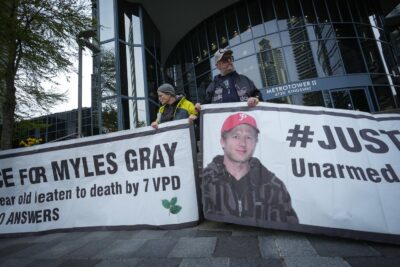
VANCOUVER — A paramedic testifying at a public hearing into the 2015 death of Myles Gray says he had trouble intubating the man and was told by a Vancouver officer that police had used batons and a “lateral neck restraint” as they tried to make an arrest.
Stephen Shipman, an advanced life support paramedic who responded to the scene in August 2015, testified that Gray was in cardiac arrest when he arrived.
He says primary care paramedics had been conducting CPR on the man, who “had bruises to parts of his body,” and was lying on his back with an IV already started.
He says he and his partner took over resuscitation efforts when they arrived, but Gray had been unusually difficult to intubate because there was significant swelling in his airway.
The hearing by the Office of the Police Complaint Commissioner is looking into the actions that day of seven Vancouver police officers, all of whom were cleared of misconduct in 2024 by a police discipline authority.
Shipman says he was told by an officer that they had used the neck hold, what he testified might have been a rear naked choke in his own judo practice, but noted he was not an expert in policing tactics.
When asked if it would have been important to his assessment of the impacts of the restraint on Gray to know that he had continued to fight for about 10 minutes, Shipman said “possibly” because “some swelling is instant, some takes time.”
Shipman said among the efforts to revive Gray was the administration of medication and attempts to “pace” his heart.
Referring to his report from that day, he said resuscitation efforts were discontinued at 4:21 p.m.
“(I’m) not trying to be rude but he had passed away. He was dead when I got there and he was dead when I left,” Shipman told the hearing Thursday.
The report, which was read out as Shipman was questioned, stated that Gray had bruising to the head and neck and “blood in his oral cavity.” It said he had no neural function and “long bruising” created by a baton, but had no obvious trauma to the abdomen or back.
He also confirmed previous testimony from another paramedic, Scott McEwen, who told the hearing that the injuries to Gray’s neck were consistent with a hanging, though Shipman noted such an injury would appear differently externally.
“If somebody is being hung, you’ll have ligature marks on the outside,” he said.
McEwen told the hearing Wednesday that they had conducted CPR for about 30 to 40 minutes and also had difficulty intubating Gray on the scene when he was in cardiac arrest.
Later Thursday, an officer who had offered his assistance at the scene after hearing about the incident on his police radio testified at the inquiry.
Const. Gordon Stokes said he arrived and saw two officers who had been injured in the altercation. He said he then walked up the stairs to the lawn where Gray had been apprehended and saw the handcuffed man on his side in the recovery position and breathing.
He said he was also the person who showed the advanced life support paramedics where to go once they had arrived at the scene.
A coroner’s inquest in 2023 heard that Gray was left with injuries, including a fractured eye socket, a crushed voice box and ruptured testicles.
The coroner’s jury ruled the death was a homicide. Coroner’s inquests do not find criminal fault and a finding of homicide means death due to injury intentionally inflicted by another person.
Police had originally been called to a complaint of a man who sprayed a woman with water from a garden hose.
This report by The Canadian Press was first published March 5, 2026.
Brieanna Charlebois, The Canadian Press
25-24