


Lawyers tell Supreme Court Quebec’s Bill 21 goes beyond legal scope
By Canadian Press on March 23, 2026.
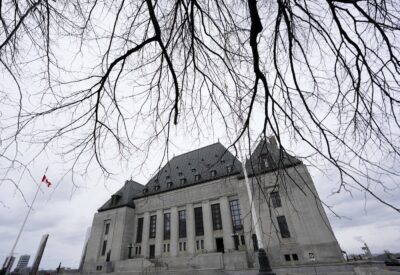
OTTAWA — Lawyers challenging Quebec’s secularism law Bill 21 went before the Supreme Court of Canada on Monday arguing the legislation goes too far and is unconstitutional.
The lawyers also argued the Quebec government overstepped its provincial jurisdiction on matters of linguistic minorities, religious freedoms and gender equality when it introduced Bill 21.
Ichrak Nourel Hak, named as an appellant in the case, said the law discriminates against and excludes religious minority groups and places them at a disadvantage by preventing them from working in fields like education.
“Instead of making room for them, they are being erased,” she told reporters. “A society that tells people to choose between their careers and their identity is not a fair society.”
The case stems from a law passed in June 2019 by the Quebec government led by François Legault. It bans certain public-sector workers — including teachers, police officers and judges — from wearing religious symbols on the job in the name of state neutrality.
The Coalition Avenir Québec government pre-emptively invoked the notwithstanding clause of the Canadian Charter of Rights and Freedoms to shield the law from most court challenges over fundamental rights violations.
Eight lawyers representing the school board, a teachers union, the World Sikh Organization, the Lord Reading Law Association and individual appellants pleaded their case on the first day of what is expected to be a four-day trial.
The outcome of the Supreme Court case could affect how provinces can use the clause to circumvent Charter rights. It could also threaten Canadian unity ahead of a Quebec election with an independence referendum on the line.
Perri Ravon, a lawyer representing the English Montreal School Board — the main appellant in the case — told the panel of judges that freedom of religion is protected by articles guaranteeing linguistic minority rights and gender equality.
Ravon argued that religious diversity is part of Quebec’s anglophone culture and is therefore protected by a clause that cannot be overridden by the legislation.
When the case was first heard at the Quebec Superior Court, Judge Marc-André Blanchard suspended some provisions of the law for English schools. His exemptions were overturned by the Court of Appeal.
Several Supreme Court justices, including Malcolm Rowe and Suzanne Côté, suggested Quebec does have some say over how it manages schools and public institutions, including hiring standards.
They also pressed Ravon on whether multiculturalism truly falls under linguistic minority protections. He insisted culture and language are deeply tied.
The lawyer also argued Bill 21 goes against Charter articles protecting gender equality, which are not subject to the notwithstanding clause.
“That is the constitutional bargain,” she said. “It was not just the notwithstanding clause that was crucial to the Constitution, but also the scope.”
Several rights groups and lawyers have argued Bill 21 particularly affects Muslim women, who cannot wear the hijab while performing their duties as teachers and daycare workers.
While a grandfather clause protects those already working in the system, allowing them to keep wearing their religious garb, they cannot change sectors or accept a promotion.
Prior to the hearings, stakeholders and members of rights groups told journalists that religious minorities — namely Muslim women, Sikhs and Jewish people — have been made to feel like second-class citizens.
Olga Redko, a lawyer representing appellants including Nourel Hak, argued Bill 21 is legislation motivated by morality, which is outside provincial jurisdiction. She added that Quebec is implying those expressing their religious faith are harmful.
“The state is sending the message they are not worthy of participating in public life because they go against Quebec values,” she said of those like her clients.
Lawyers representing the World Sikh Organization pointed to pre-Confederation laws from 1852 protecting minority rights, including the right to choose and practise the religion of one’s choice.
But Supreme Court Chief Justice Richard Wagner asked whether Quebec’s unique relationship with religion — the provincial government’s close ties with the Catholic Church until the Quiet Revolution of the 1960s — should be taken into account.
The province has debated reasonable accommodation of religious minorities for decades.
Other lawyers brought up the far-reaching domino effect of Quebec’s pre-emptive use of the notwithstanding clause.
Frédéric Bérard, a lawyer for the teachers union Fédération autonome de l’enseignement, said the clause has been used in unprecedented ways.
He pointed out that it has been used pre-emptively to circumvent Charter rights in Alberta and Saskatchewan since Quebec adopted Bill 21.
He added that the pre-emptive use of the notwithstanding clause goes against the spirit of the law, which is meant to encourage dialogue. He argued the law should only be used after courts try to intervene on legislation.
Justice Rowe told Bérard dialogue is a “fable” if judges can impose their decisions on provinces, which can then invoke the notwithstanding clause to have the “final say.” Justice Côté also asked him if it should be up to the electorate to pass judgment on a government that circumvents rights, since the notwithstanding clause must be renewed every five years.
Bérard argued that assumption rings false in the current political climate.
“The vast majority of politicians in Quebec are saying they need the notwithstanding clause because … Ottawa is not going to decide for us,” he said.
The Quebec Superior Court and the Quebec Court of Appeal have mostly sided with the provincial government in its rulings, while also criticizing how the government has employed the notwithstanding clause.
The hearings will resume Tuesday with lawyers from pro-secularism groups.
This report by The Canadian Press was first published March 23, 2026.
— By Erika Morris in Montreal.
The Canadian Press
38-37