


NASCAR chairman Jim France called ‘a brick wall’ in contentious revenue-sharing negotiations
By Canadian Press on December 4, 2025.
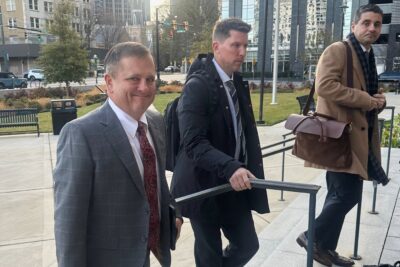
CHARLOTTE, N.C. (AP) — The attorney for the two teams suing NASCAR portrayed series chairman Jim France as “a brick wall” in negotiations over the new revenue-sharing model that has triggered the Michael Jordan-backed federal antitrust case against the top form of motorsports in the United States.
23XI Racing, owned by Basketball Hall of Famer Jordan and three-time Daytona 500 winner Denny Hamlin, and Furniture Row Motorsports, owned by fast food franchiser Bob Jenkins, were the only two organizations out of 15 that refused to sign extensions on new charter agreements in September of 2024.
A charter is the equivalent of the franchise model used in other sports and in NASCAR guarantees every chartered car a spot in all 38 races, plus a defined payout from NASCAR.
NASCAR spent more than two years locked in bitter negotiations with the teams over the extensions because the teams made specific requests in an attempt to improve their financial position. The deal ultimately given to the teams on the eve of the start of the 2024 playoffs lacked most of those requests and gave teams a six-hour deadline to sign the 112-page document.
Jeffrey Kessler, attorney for 23XI and Front Row, spent much of Thursday trying to portray France as the holdout in acquiescing to the teams. NASCAR was founded 76 years ago by the late Bill France Sr. and to this day is privately owned by the Florida-based family. Jim France is his youngest son.
Kessler questioned NASCAR President Steve O’Donnell for more than three hours in a contentious session in which the attorney at times was shouting at the executive. He used internal communications among NASCAR executives to demonstrate frustration among non-France family members over the slow pace of negotiations and Jim France’s refusal to grant the teams permanent charters. The charter system was established in 2016 as a means to create stability for the teams, and the charters are renewable.
One particularly tense exchange involved an impassioned letter sent by Heather Gibbs, daughter-in-law of team owner Joe Gibbs, in which she implored France to grant permanent charters to help secure the family business.
O’Donnell in a text message told Ben Kennedy, nephew of Jim France, “Jim is now reading Heather’s letter out loud and swearing every other sentence.”
Pressed by Kessler as to what France was saying as he read the letter, O’Donnell said the chairman never swore. Kessler tried to force O’Donnell to reconcile what he wrote to Kennedy, but O’Donnell maintained that his boss was not cursing.
“That’s what I wrote, but he was not doing that,” O’Donnell testified. “We were all taken aback by the letter. I think Jim was frustrated, as we all were.”
Kessler then demanded what sort of gestures or actions France made that led to O’Donnell to tell Kennedy he was swearing. A judge-ordered break in the session prevented O’Donnell from ever clarifying why he characterized France’s reaction that way.
But the internal communications among executives showed the mounting frustration over both the slow pace and direction of the negotiations. As O’Donnell, Commissioner Steve Phelps and others tried to find concessions for the teams, they all indicated they were met by resistance time and again by France and his niece, vice chair Lesa France Kennedy.
“Mr. France was the brick wall in the negotiations,” Kessler said to O’Donnell.
“Those are your words, not mine,” the executive replied.
Teams told NASCAR they were fighting for financial survival
Earlier Thursday, O’Donnell testified that teams approached the sanctioning body in early 2022 asking for an improved revenue model, arguing the system was unsustainable.
O’Donnell was at the meeting with representatives from four teams, who asked that the negotiating window on a new charter agreement open early because they were fighting for their financial survival. The negotiating window was not supposed to open until July 2023.
O’Donnell testified that in that first meeting, four-time series champion Jeff Gordon, now vice chair of Hendrick Motorsports, asked specifically if the France family was “open to a new model.”
Kennedy, great-grandson of NASCAR’s founder, told Gordon yes.
But O’Donnell testified that chairman France was opposed to a new revenue model.
The teams have maintained that the deal ultimately given to them was “take it or leave it.” 23XI and Front Row were the only teams that refused to sign and instead sued in federal court over antitrust allegations.
O’Donnell said the teams had very specific requests: maximized television revenue, the creation of a more competitive landscape, a new cost model and a potential cost cap.
NASCAR spent the next few months in internal discussions on how to approach the charter renewal process, said O’Donnell, who was called as an adverse witness for the plaintiffs. NASCAR acknowledged the teams were financially struggling, and worried they might create a breakaway series similar to the LIV Golf league.
In a presentation made to the board, O’Donnell listed various options that both the teams and NASCAR could take. O’Donnell noted the teams could boycott races, build their cars internally, and race at non-NASCAR owned tracks, or potentially sell their charters to Liberty Media, the commercial rights holder for Formula 1.
“We knew the industry was challenged,” O’Donnell testified.
As far as NASCAR’s options, O’Donnell told the board it could lock down an exclusivity agreement with tracks not owned by NASCAR, dissolve the charter system, or partner directly with the drivers.
The extensions that began this year upped the guaranteed money for every chartered car to $12.5 million in annual revenue, from $9 million. Hamlin and Jenkins have both testified it costs $20 million to bring a single car to the track for all 38 races. That figure does not include any overhead, operating costs or a driver’s salary.
Furniture Row owner details his frustrations with NASCAR
Jenkins opened the fourth day of the trial with continued testimony. He has said he has lost $100 million since becoming a team owner in the early 2000s — and that’s even with a 2021 victory in the Daytona 500. He said Thursday he “held his nose” when he signed the 2016 charter agreements because he didn’t think the deal was very good for the teams but a step in the right direction.
When the extensions came in 2024, Jenkins said the agreement went “virtually backward in so many ways.” Jenkins said no owners he has spoken to are happy about the new charter agreement because it falls short of so many of their requests. He refused to sign because “I’d reached my tipping point.”
Jenkins said he was upset that France refused a meeting the week before the final 2025 offers were presented with four owners who represented nine charters, only to learn France was talking to other team owners.
“Our voice was not being heard,” said Jenkins, who believes NASCAR rammed the 2025 agreement through. “They did put a gun to our head and got a domino effect — teams that said they’d never sign saw their neighbor sign.”
Jenkins also said teams are upset about the current Next Gen car, which was introduced in 2022 as a cost-saving measure. The car was supposed to cost $205,000 but parts must be purchased from specified NASCAR vendors and teams cannot make any repairs themselves, so the actual cost is now closer to double the price.
“To add $150,000 to $200,000 to the cost of the car — I don’t think any of the teams anticipated that,” Jenkins testified. “What’s anti-competitive is I don’t own that car. I can’t use that car anywhere else.”
___
AP auto racing: https://apnews.com/hub/auto-racing
Jenna Fryer, The Associated Press
-39