


Hamilton Tiger-Cats, Saskatchewan Roughriders earn top grades in CFLPA report cards
By Canadian Press on January 7, 2026.
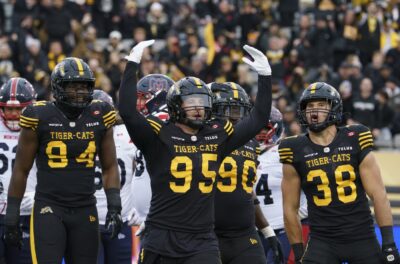
TORONTO — The Hamilton Tiger-Cats, among the CFL’s top teams last season, have earned the distinction of being its best franchise off the field.
Hamilton, which finished atop the East Division in 2025, received five As and five Bs in the CFL Players’ Association’s second annual team report cards, which were released Wednesday.
The top grades came in football operations, facilities/equipment, strength and conditioning, team travel and training camp while Bs were for coaching staff, ownership/business operations, therapy/medical staff, nutrition/diet and treatment of families.
“My club ranked highly last year and still elected to make improvements,” a player remarked anonymously about the Ticats. “This club is the class of the CFL and goes beyond the call of duty.
“They even hosted Thanksgiving dinner for the players AND their families.”
The Grey Cup-champion Saskatchewan Roughriders also earned five As (coaching staff, football operations, strength and conditioning, team travel and training camp). They received Bs for all but treatment of families, securing a C, while also earning criticism for community appearances.
“Issues with community appearance money,” one player remarked. “Appearances were not offered at the rate expected, very slow.
“Great improvements in nutrition, coaching, family events, strength training, so many improvements. Strength and conditioning staff really levelled up.”
The CFLPA distributed its 78-question survey online to all players on CFL rosters (active and practice rosters and injured list), with 381 sharing their experiences. Last year, 495 participated in the evaluation, which consisted of 58 questions.
The survey included multiple choice, rating, and open-ended questions in each category. Scores were averaged with grades incorporating various aspects of workplace conditions, including the quality of team facilities and services offered.
Only two Fs were given, to the B.C. Lions (nutrition/diet) and Montreal Alouettes (treatment of family).
“The overall nutrition of our team is very below par and what it should be for a professional football team,” a player commented about the Lions. “This needs major improvement.
“Nutrition is 99 per cent on the players here.”
Another said that in Montreal, “Family support and treatment on gameday is non existent and in my opinion needs the most improvement of any category.”
Last year, the Edmonton Elks received the lone two Fs for both nutrition/diet as well as training camp. This time around, the franchise earned C-minus and C-plus grades for the respective categories as well as two As (A-minus for facilities, A-plus for team travel) and no failing marks overall.
But the Elks still faced criticism.
“Terrible rehab planning and extremely inconsistent,” one player commented. “Lack of useful feedback in order to progress from being injured.
“Lack of treatment to both injured and non injured players. Food before and after practice was the best it’s been in years but you have to pay for it.”
And accommodations in Edmonton for visiting players was the most commented issue in the survey, with a player saying: “The hotel in Edmonton is unacceptable.”
Also receiving As were Montreal (A-minus, coaching staff) and the Toronto Argonauts (A for therapy/medical staff and team travel, A-minus for strength and conditioning).
But Montreal earned Ds for ownership/business operations and facilities/equipment. The Calgary Stampeders also received two Ds (therapy/medical staff, treatment of families).
“Not enough trainers and attention to detail,” a player commented about the Alouettes. “Lack of machines that work and are up to date.
“Tubs are consistently broken and not at the right temperatures or maintained for an entire team use. Training room needs a lot of work to keep professional standard.”
Toronto (coaching staff), B.C. (treatment of families) and Ottawa (strength and conditioning) also earned Ds. The Redblacks also drew condemnation for their training camp at Queen’s University in Kingston, Ont., last year.
“The facility and lunch room were too far to walk to from your dorm room,” a player said. “The shuttles they had running were not convenient at all and not always available.
“That added much stress to parts of training camp that wasn’t completely necessary.”
The CFLPA again collaborated with Dr. Desmond McEwen, an assistant professor in sport psychology at the University of British Columbia. The union said the survey’s primary goals are to highlight teams that are setting positive examples and identify areas where improvement is needed.
The CFLPA is following in the footsteps of the NFL Players’ Association, which released its first team report cards in 2023.
This report by The Canadian Press was first published Jan. 7, 2026.
Dan Ralph, The Canadian Press
-32