

Poll
Do longer days actually improve your mood?
- Yes (70%, 332 Votes)
- No (30%, 141 Votes)
Total Voters: 473
 Loading ...
Sponsored
Flood of the century: a look back at the historic southern Alberta flood of ‘95
By Lethbridge Herald on January 1, 2026.
 Lethbridge Herald photo
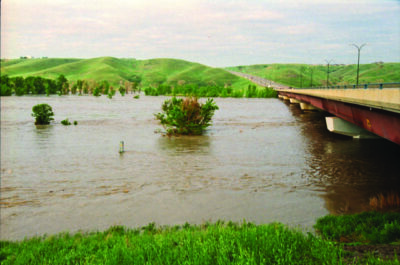
The flooding Oldman River nears the Whoop-Up Drive bridge deck - June 1995
Lethbridge Herald photo
The flooding Oldman River nears the Whoop-Up Drive bridge deck - June 1995By Nathan Reiter
Local Journalism Initiative Reporter- Lethbridge Herald
It’s been three decades since southern Alberta faced the fury of the Oldman River in June 1995, but anyone who lived through it remembers the experience in vivid detail.
The flood was caused by heavy rain in the area. The city of Lethbridge saw 55 mm of rain with some areas west of the city seeing nearly 300mm in a short time period.
David Carpenter, who was the mayor of Lethbridge in 1995, knows all too well the power of the river. Growing up, Carpenter’s father was the chief of police. During the flood of 1964, constable Calvin Byam was swept away by the flood waters.
“Dad was really, really upset about that.” Carpenter explained in an interview with the Herald earlier this month. “I kind of learned firsthand just how serious flooding can be.”
Years later, Carpenter got an up close and personal encounter with the river in 1975 when he was working in the road construction business. While checking on a gravel crusher in the river valley downstream from the city, Carpenter’s vehicle got stuck and he had to evacuate by crawling up a muddy hill before being rescued the following morning.
Carpenter says those experiences from earlier in his life helped him when he took over as mayor beginning in 1986.
“When I became mayor, we put a lot of emphasis on emergency preparation. We had a group called the Emergency Operations Centre (EOC). The person in charge of it, I believe, was the deputy fire chief and the police chief was in charge of security in all these situations. The job of the politician, that would be me in those days, was to communicate with the people.”
Carpenter says the EOC had plans and had done dry runs for several events including the possibility of a major car accident on Highway 3 occurring at the same time as a plane crash at the airport.
According to a 1989 research study published by the late historian Alex Johnston at the Galt Museum, stream gauges were installed in the river at Lethbridge in 1909 and have monitored peak and normal flows ever since.
The flood of 1995 saw a peak flow of 160,000 cubic feet per second (cfs) with the river cresting at 8.4 metres or 27.5 feet. At one point during the flood, it was forecasted by Environment Alberta that the river would crest at 10 metres above normal.
If the river did hit the forecasted 10 metre crest, it could have proven disastrous for the city. Despite efforts, the sewage treatment plant was severely damaged and raw sewage was being put into the river at one point. The water treatment plant was able to hold on thanks to the efforts of volunteers putting down sandbags.
“I was worried that we wouldn’t get enough volunteers to be able to protect the water treatment plant.” Carpenter explained. “If the water treatment plant went, I don’t know what we would have done. I would say in about 30 minutes there were so many volunteers that we had to stop asking. Even now, I tear up when I think about people’s commitment to our city. It’s just absolutely amazing. To all the people that worked, my heartfelt thanks.”
During the flood, the filters in the water treatment plant needed to be cleaned about once every 12 hours due to the turbidity of the water.
Prior to 1995, the most significant flooding events to be recorded in Lethbridge occurred in 1975 when the Oldman had a flow of 101,000 cfs and crested at 23 feet above normal.
In 1953, the river had a flow of 110,000 cfs and crested at 23.1 feet. The 1953 flood closed the city-owned power plant for a week, reduced the community water supply by half and forced midnight evacuation of more than 150 people. That flood also led city council to convert the riverbottom, then known as Riverside, to a park and recreation area now known as Indian Battle Park.
The largest flood event in Lethbridge to not be officially measured occurred back in June of 1908. The river crested at 26.7 feet with an estimated flow of 200,000 cfs. Some observers estimated the peak of the flood to approach 250,000 cfs. The flood washed away a significant portion of the substructure for what would become the High Level Bridge.
Carpenter says the study done by Johnston gave the city a good idea of what to expect, but the events of 1995 surpassed their wildest expectations.
“We had all of those records as to roughly what the flood would look like. What we tried to do was make sure that all of our people were prepared for a flooding event in that range, 100,000 to 110,000 cfs. Along comes 1995 and all of a sudden we find out that this now is not 105,000. This is closer to 160,000 and cresting towards 27 feet above normal. We did have the plans and we were prepared, but this was well beyond what anyone thought.”
Sherri Gallant was a Lethbridge resident who had a front row seat to the flood. At the time, Gallant worked as a reporter for the Lethbridge Herald and covered the event up close along with the rest of the Herald newsroom which included Dawn Sugimoto, Craig Albrecht, Ron Devitt, Janine Ecklund, Joy Hickson, Joanne Helmer and Delon Shurtz. Laura Campbell and David Rossiter captured photos of the event with other contributions from Brian Price and Lisa Kubik.
The flood caused both the Highway 3 and Whoop Up Drive bridges to be closed. With the Herald offices being located on the southside and Gallant residing on the westside, she was one of many residents stuck because of the river’s rage.
Because of the emergency situation, Gallant and the rest of the Herald newsroom worked around the clock. Gallant recalls working a shift that lasted more than 24 hours covering the events of the flood as they unfolded.
“I couldn’t get back home to the west side because the highway was closed for a certain length of time at the same time.” Gallant explained. “People were stranded on both sides of the river and that was sort of something that never happens and if it does, it’s maybe once in your whole career. You don’t forget it and during that long shift, we were tired but we were also so full of adrenaline because we knew this was an emergency situation and so much could happen that we were excited to cover it.”
While Gallant wasn’t in the Herald newsroom, she would sometimes take a break and walk over to the nearby Robin’s Donuts along 6 Ave S to grab a coffee and take a peek at the current level of the river. Robin’s Donuts has long since closed and the building today is occupied by Elevate Construction Partners.
Every four hours during the crisis, the EOC would host an update for members of the media in the basement of the old courthouse. The updates were held during the most crucial 48-hour period. Gallant says the city did a great job at handling the situation from a communications perspective.
“In many instances in my career in living in Lethbridge, I’ve been impressed by the infrastructure, the city services, and whoever was in power at that time, David Carpenter as mayor and his administrative team and the elected officials, they just were so good. They handled everything so well. I think as reporters you sometimes see behind the curtain and you see that there’s cracks, but I think the city was fairly well proud of what was in place after that event, and that’s a good feeling too.”
While the Oldman River has flooded in the years since, it has never reached the levels that it did in 1995. In 2014, the river reached a flow of about 74,000 cfs and it was reported that officials were fearing that the Oldman could reach 1995 levels at that time. During peak spring conditions, a flow of 30,000 cfs is considered normal.
Gallant says the flood of 1995 was particularly memorable because of how quickly everything took place.
“One was the speed with which it happened. That was surreal. When I look back, that was the one thing that scared me personally was just how fast it happened. You could watch the river coming up and you could see it coming towards the bottom of the bridge and the flow rate of it. It was just raging and wild and it was scary. To stand on the top of the coulee behind what’s now Sandman, it was the Lodge then, and see the fort filled with water and the bridge looking like a road that was floating on water. It was just mind-boggling and it’s not just that it was that high, it spread so wide that it looked like the Mississippi. It didn’t look like the Oldman.”
Because of the rainfall that led to the flood, several residents experienced flooded basements throughout the city after 55mm of rain fell in 24 hours but no homes were destroyed. The rising waters provided a scare to residents of Paradise Canyon, which was newly developed at the time. The Herald reported that water came within 10.5 metres of the bottom deck of Sheila and John Pylypiuk’s residence which sat along the 13th fairway.
The golf course at Paradise Canyon sustained damage to eight holes. For the Lethbridge Country Club, 10 of the course’s 18 holes were swamped. Holes one through eight along with 17 and 18 sustained major damage.
“In some places, there was six feet of water on the green and some places it reached 10 to 14 feet.” Country Club superintendent Kelly Collinge said to the Herald in an article that ran on June 9, 1995. “The water was moving at a real rapid current. It wasn’t just the overflow of the river, it was the river.”
Another member of the community who had a front row seat to the flood was Liane Vance who worked as a video journalist for CISA-TV which was also known as 2&7 at the time. CISA-TV is still on the air today as Global Lethbridge.
“The community came together, not just the city of Lethbridge, but all of southern Alberta,” Vance recalled. “I remember specifically for the city of Lethbridge, they were worried about the wastewater treatment plant being compromised. Citizens that were down there just sandbagging away, and it was so incredible to see.”
Vance and the rest of her colleagues helped produce a long form report that aired called Flood of the Century. The full report is available to watch in its entirety on YouTube as it was uploaded by Chris Oates in 2019. The report covers not only the flood in Lethbridge but across southern Alberta from Pincher Creek, the Blood Reserve and Medicine Hat.
Vance, who went by her maiden last name Sadlemyer while on the air, says it was an incredible project to be a part of looking back on it years later.
“We worked together as a team and how everybody did their job. Everybody was working on very limited sleep. I was covering the city of Lethbridge but my colleagues, they were covering out in Pincher Creek and so they had even further drives to go but everybody worked so hard. The editors, the directors, the operators back at the station and our news director, everybody was just pitching in and it was really amazing. At that time, you couldn’t edit video on the fly as you can today. You actually had to go back into the studio and edit then just to turn that all around so quickly and make the documentary really a testament to not just the work ethic but the care and the concern for the community that everybody had.”
Drastic measures were taken in order to save both bridges in Lethbridge. More than three metres worth of sand and gravel ballast was placed on the deck of the Highway 3 bridge. At the peak of the flood, the water level was lapping onto the deck of the bridge but the ballast helped preserve the structure of the bridge.
On Whoop-Up Drive, crews attached steel cables to concrete piers below the deck. In addition, cutting torches were used to make holes in the pontoons under the bridge. As the water level rose, the river would rush through the pontoons providing liquid ballast to help secure the bridge.
“If we don’t do that, the river could come up underneath and the pressure might just push the bridge away,” city transportation general manager Bud Hogeweide told the Herald in 1995.
Carpenter says the work done on the Whoop-Up bridge was especially treacherous.
“I would have paid those guys anything. It was so dangerous. In the dark of night, hanging onto the bridge, cutting those holes in the bridge pontoons. (It’s a) really, really significant commitment to the city.”
According to the research done by Alex Johnston, a 1 in 1000 year flood would reach a peak flow of 156,000 cfs while a 1 in 100 year flood would peak around 106,000 cfs. It is highly unlikely that anyone who was alive for the flood in 1995 will witness a similar event in their lifetime.
Notable quotes from the Herald
coverage of the flood
“It makes you appreciate how awful this would be if (the flood) was in a townsite. I’ve seen other disasters on TV but this was close to home. I had to come down and see it for myself.” – Jacquie Hurt
“I don’t remember the river being quite as wild as it is today.” – Dr. Robert Hall
“All I can say is unbelievable. I think the last time water came down here this fast was when Noah built his ark.” – Pat Shimbashi, president of Paradise Canyon Golf and Country Club in 1995.
“They said we’d never see a flood like this in our lives because we control the water. But you can’t control nature.” – Emery Grier of Brocket, who said he believed the dam would stop flooding on the Oldman River.
“I never thought there would be that much water in the mountains.”- Kenny Piecharka, age 12 of Lethbridge.
“Basically, the water came through here and wiped us out. We lost stockpiles, suffered considerable damage to our asphalt plants and the office.” – Martie Tollestrup, business owner
“We came home from school at 3:30 p.m. and the water was just coming up on the banks and an hour later, we were evacuated. It was scary.” – Daniel Ouellette, 16, on being evacuated from her Pincher Creek home
“It just amazes me how lucky we were in Lethbridge. That no one was hurt with the mass of water going through, that’s unbelievable.” – Lethbridge East MLA Ken Nicol.
55-54